The weak-foot journey · ages 10–16+
Your weak foot isn't weak. It's untrained.
The honest timeline to a usable weak foot — months, not years — and how to hide the gap while you build it.
On this page
- The real timeline: embarrassing weeks, then automatic touches, then games.
- The touch base — where every weak foot has to start.
- The wall ladder: receiving beats passing.
- The split: attack the gap in training, hide it in games.
Stay to the end: the honest audit that puts a number on your weak foot.
1Two lies
What have you been told about your weak foot?
Lie one: 'just use it more and it'll come' — untargeted use produces progress so slow most players quit. Lie two: 'you're behind because of it' — most of your teammates can't use theirs either; they hide it better. The truth: it's a wiring problem. Your strong foot has years of reps; the other one is simply untrained. Wiring builds on a schedule.
The real timeline: weeks 1–2 feel embarrassing (that's wiring, not failure) · weeks 3–6 simple touches stop needing thought · months 2–3 passing becomes trustworthy · months 4–6 it shows up in games uninvited. Most players quit at week three — right before the curve turns.
Everything stands on touch — start below your ego. ↓
2The touch base
Where does the building actually start?
Rolls, taps, inside-outside, drags — weak foot only, slow, small space. Use the home-session split: half of every session belongs to this foot alone. And know the hidden half: most early 'weak foot' clumsiness is actually a wobbly plant leg learning its new job. Slow is the tempo. Perfect is the standard.
Then the wall — where the weak foot learns to be trusted. ↓
3Passing, receiving, finishing
What order do the skills come in?
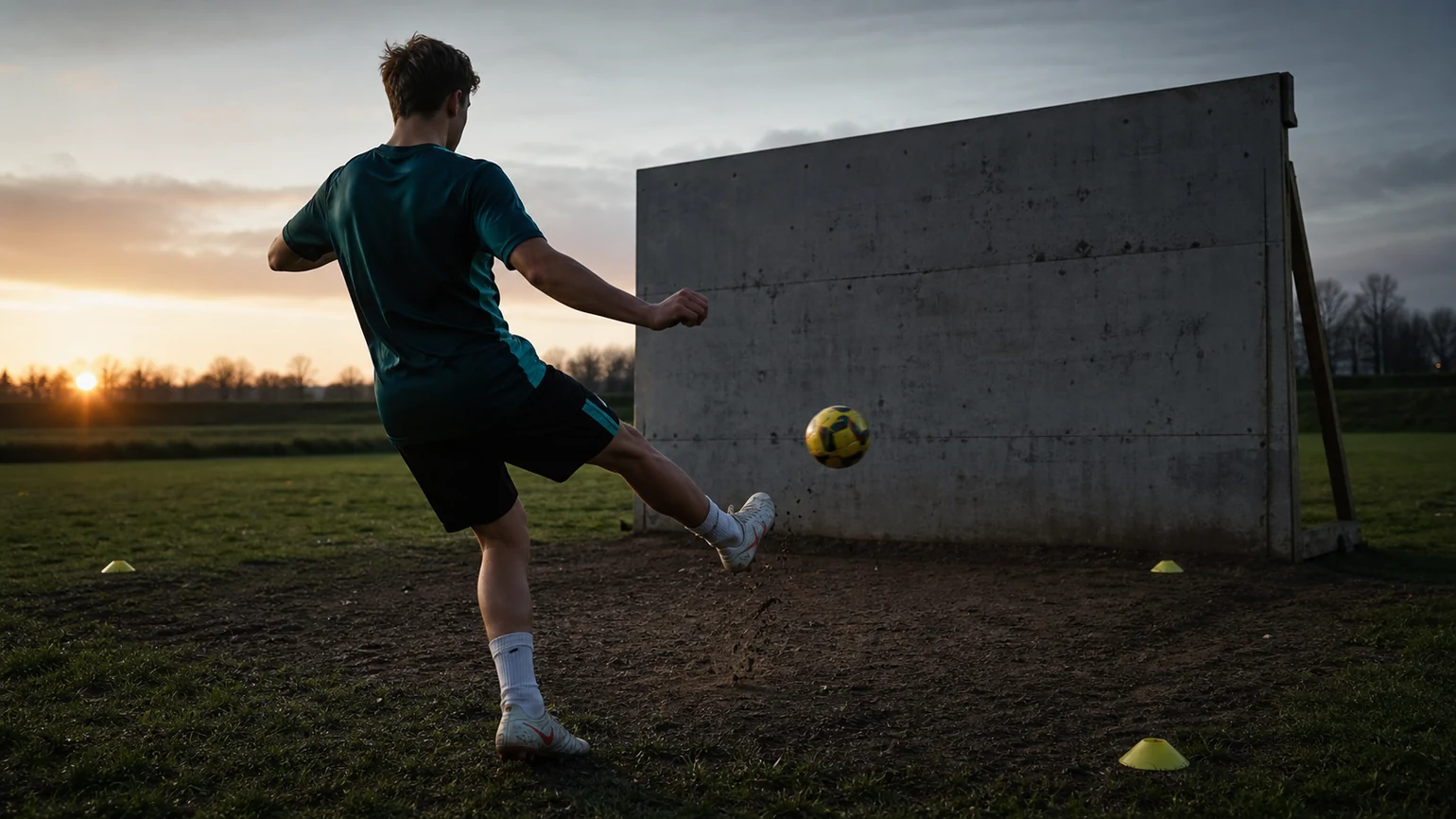
Receiving matters more than passing — a weak foot that can kill a ball opens the whole field, because you can receive on either side and play facing forward. The wall ladder: strong-receive/weak-pass → weak-receive/strong-pass → weak-to-weak → first-time weak. Finishing comes LAST, close and mechanical first: placement is a weak foot's best friend — a passed finish into the corner doesn't care which foot hit it.
SUGGESTION — four-rung wall sequence on the weak side, streak counter, deliberately unglamorous pace.
The side-split rule, from a real session: split your training space in two — everything on the left side gets the LEFT foot only: touches, fake shots, passes. 'It comes on that side? It comes on your left foot.' The space decides the reps, so the weak foot can't hide.
Meanwhile — play smart with the gap you still have. ↓
4Try it this week
What's the split — and the audit?
- The audit: film one match, count your weak-foot touches. Most players: under ten, half accidental. That's your baseline number.
- The split: in training, attack the gap on purpose — half of every home session, weak foot only. In games, hide it like pros do: body shape that opens your strong side early, first touch onto the good foot before pressure arrives.
- Re-count in one month. The number climbing is your wiring changing, on camera.
Two-footed in one sentence: half of every home session on the untrained foot, receiving before passing, finishing last — and since almost nobody does this work, a merely usable weak foot isn't catching up. It's overtaking.
The road continues
Next phase — The Home Training System
The weak foot is building. Next: the 20-minute reps engine that compounds it all.
Continue