The home-training journey · ages 10–16+
The gap doesn't close on Tuesday night
Twenty structured minutes in a backyard beat most team trainings — because every second is aimed at YOUR weakness.
On this page
- Why home reps compound: failure is free and the maths is brutal.
- The 20-minute structure with the weakness block at its core.
- Wall work — the best training partner you'll ever have.
- The weekly plan that makes it stick.
Stay to the end: the one-page session you can run tomorrow.
1The maths
Why does home training beat team training?
Team training is shared: one coach, sixteen players, the team's needs. Home is aimed: ten focused minutes a day is three hundred a month on exactly the thing YOU need — with nobody watching, where failing fifty times costs nothing. That's the price of the fifty-first rep that works.
Random practice produces random results — so the 20 minutes get a structure. ↓
2The structure
What do the 20 minutes look like?
Minutes 1–3: quick feet. Small fast touches, wake the feet up. Minutes 4–13: the weakness block — one gap, one pattern, full focus; at least half the session lives here. Minutes 14–18: a game with rules — targets, points, a constraint that punishes sloppiness. Minutes 19–20: free. One session, one weakness. Not four.
The details that make it work: little steps between every touch — step, step, step — never flat-footed waiting; stay on your toes, lean over the ball; control the intensity of every touch. Slow and perfect first. Speed arrives on its own.
Your best equipment is a wall — used in layers. ↓
3Wall work
How do you train alone without it going stale?
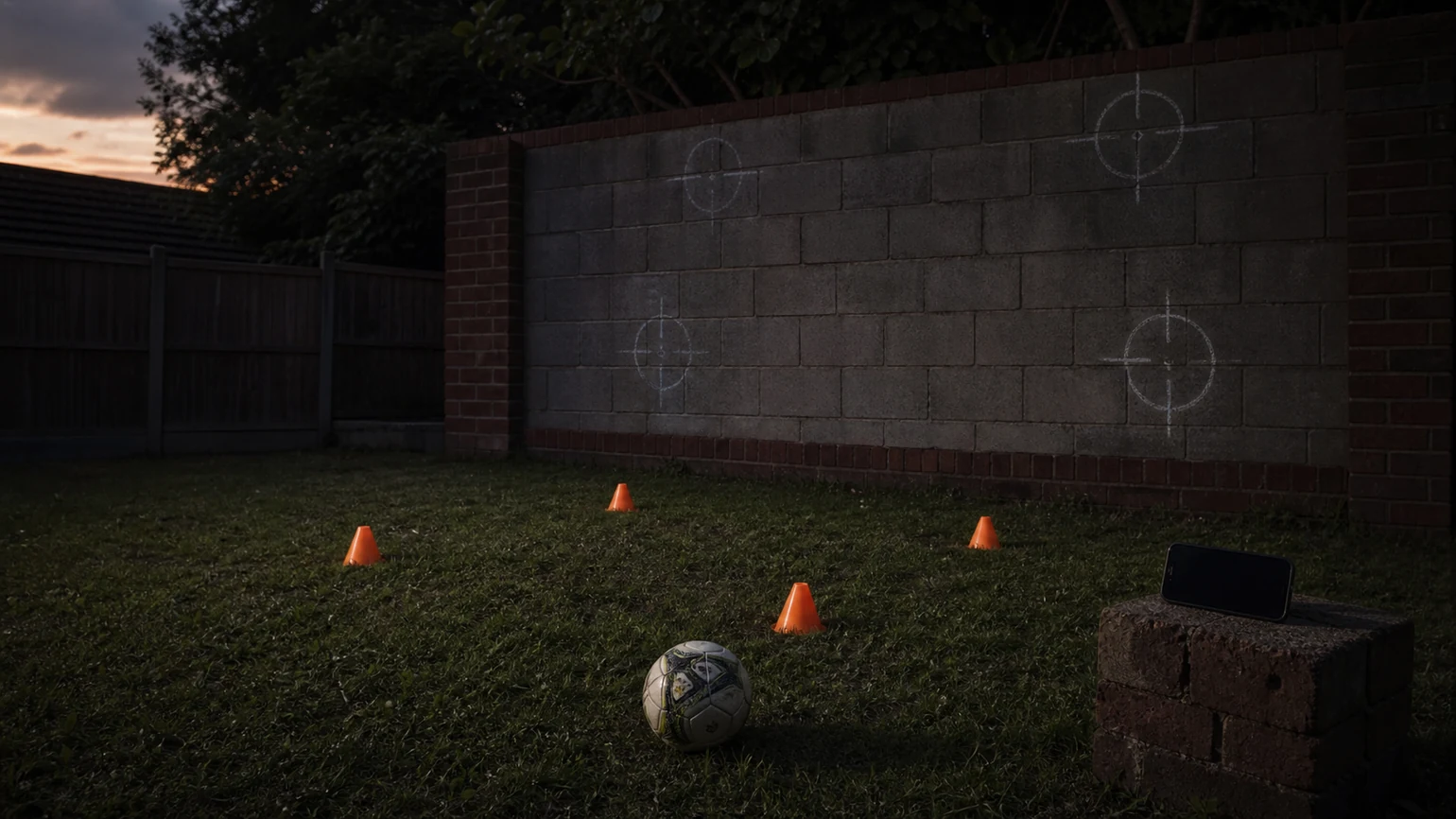
The wall returns every ball and grades every pass — bad pass, bad return, instant feedback. Climb the ladder: two-touch control-and-pass → first-time passing → a move between wall passes → receiving on the half-turn. Count streaks, restart on a miss. If nothing is counted, nothing is known.
SUGGESTION — tight-space wall sequence: two-touch, then one-touch, then half-turn receives, streak counter overlay.
Then zoom out — one session is nothing; the week is everything. ↓
4Try it tomorrow
What's the weekly plan?
- Build page one tonight: name your ONE weakness — honestly, it's the thing you avoid in games — and write the 20-minute split around it.
- Run 3–4 sessions this week: light after match day, short and sharp before it. Score the game block each session.
- Hold the same weakness for at least two weeks — switching daily resets the compounding. Test monthly: same drill, same rules, write the score down.
Home training in one sentence: one gap, twenty structured minutes, points on everything, three-plus times a week. The gap closes in the days between — starting tomorrow.
The road continues
You've walked the Ball Mastery road
Back to the overview — new phases land there as they're built.
Continue