Fitness phase · repeat the football action
Can you repeat the explosive action?
Football power endurance is accelerating, braking, changing direction, and pushing off again without the next ball action falling apart.
On this phase
- Why one fast sprint does not describe football fitness.
- The energy cost of braking and changing direction.
- Why the ball changes the body position and stepping pattern.
- A four-round output check with a clear stop rule.
Stay to the end: the four-round football-output check.
1The repeat
What does power endurance mean in football?
It is the ability to produce the push-off again after the game has already asked for a sprint, stop, or turn. The target is repeatable football actions, not one impressive top-speed effort.
The part players underestimate is the action that removes speed. ↓
2The brake
Why does stopping belong in a fitness phase?
Braking still requires force and control. If the player cannot lower the speed cleanly, the change of direction is late and the next acceleration begins from a poor position.
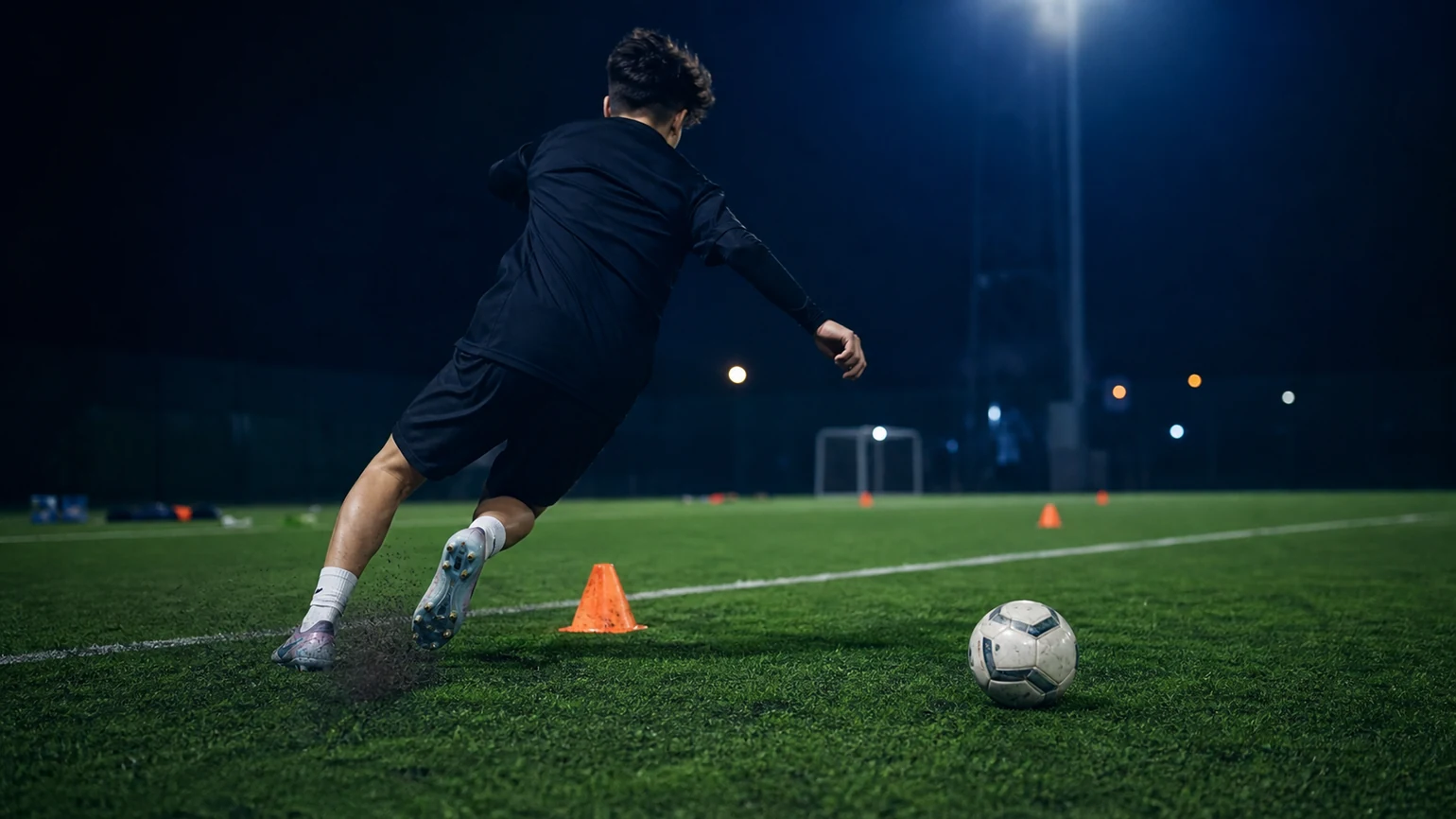
Accelerate, control the brake, change direction, then re-accelerate. The quality of the stop sets up the next action.
SUGGESTION — anonymised short sequence with and without the ball: accelerate, controlled brake, stable change of direction, re-acceleration; retain the full body in frame.
Adding the ball changes the posture and the reason for every step. ↓
3Football movement
Why not measure only straight-line speed?
Straight sprinting and moving with the ball use different positions and stepping demands. Football asks the player to stay able to touch, turn, and decide, so the useful measure is whether the next football action survives the movement.
Do the movement both ways: one rep without the ball, one with it. Compare control, not just time.
The final round shows whether the output is repeatable or only fresh-legged. ↓
4Try it today
Does the fourth round still look like football?
- After the normal warm-up, set a short channel with one brake line, one direction change, and one ball action.
- Complete four 20-second rounds with 80 seconds of walking recovery; alternate without and with the ball.
- Score the final ball action in every round for control and intended direction.
- Stop if braking becomes uncontrolled, pain appears, or the movement loses safe technique; the aim is repeatable quality, not exhaustion.
The useful engine is not the one that produces a single sprint. It is the one that can brake, turn, push again, and still play the ball on purpose.
The road continues
Back to Fitness
Return to the road and choose the next phase when you are ready.
Continue