SPECIALIST TRANSFORMATION · GAME INTELLIGENCE · AGES 11-16+
You can only focus on one thing. Pros chose it years ago.
Four layers of awareness. Pros run three on autopilot. That is the whole advantage.
On this phase
- The four awareness layers, in order.
- Why one active focus is all any player gets.
- Read the situation, not the player.
- A two-ball square game that trains it today.
Stay to the end: the two-ball square game Coach Joe uses to build each layer.
1The ladder
What are you actually aware of on the ball?
Four layers. Your own body position. Your body position in relation to the ball. Your position in the space. The opponent.
In football you can actively focus on one thing. The rest has to run passively. A pro has the first three subconscious — so the one active focus lands on the opponent. A youth player is still spending it on the ball.
DO NOT GENERATE (VIDEO PLACEHOLDER) — SUGGESTION — anonymised square-game rep, slowed: freeze four times and label one layer per freeze (body · ball · space · opponent). End on the coach line: you can only focus on one thing.
Automating a layer takes reps — and the reps have an order. ↓ ↓
2Learn it linear
How does a layer become automatic?
Linear first. You cannot copy the pro version straight away, because nothing is subconscious yet. One layer at a time: focus on your positioning and the space first — before the opponent.
Repetition presses it into the subconscious. The same way a skill becomes a skill.
The trap is skipping. Most players jump straight to watching the opponent — and give up the space behind them without noticing. The space is the layer that kills you when someone good exploits it.
Once the layers run, the read changes: situation first, player second. ↓ ↓
3Read the situation
What do pros watch that amateurs don't?
The situation, not the show. A skilful player can make you misread them — the space cannot lie. Tight space near the box, low pace, a sideline: those limits don't move, no matter how many skills come at you.
As a defender you need exactly two things from the opponent: their speed, and their most likely direction. Everything else is about you — body position, footwork, where your toes point.
Low pace means tone the reaction down. React to a feint at low pace and it is game over — the attacker gets the speed change for free.
Watch the weight. Body weight loaded on one leg, facing one way, near a corner: the most likely cut is readable before it happens. Pros calculate the most likely scenario and prepare for it — they don't guess.
DO NOT GENERATE (VIDEO PLACEHOLDER) — SUGGESTION — anonymised low-pace 1v1 in a tight square: attacker throws two big feints, defender keeps stepping, ignores both, closes the only real lane and wins the touch. Caption: read the situation, not the player.
Now build it — the same game the sessions used. ↓ ↓
4Try it today
Can you train awareness with two balls and a square?
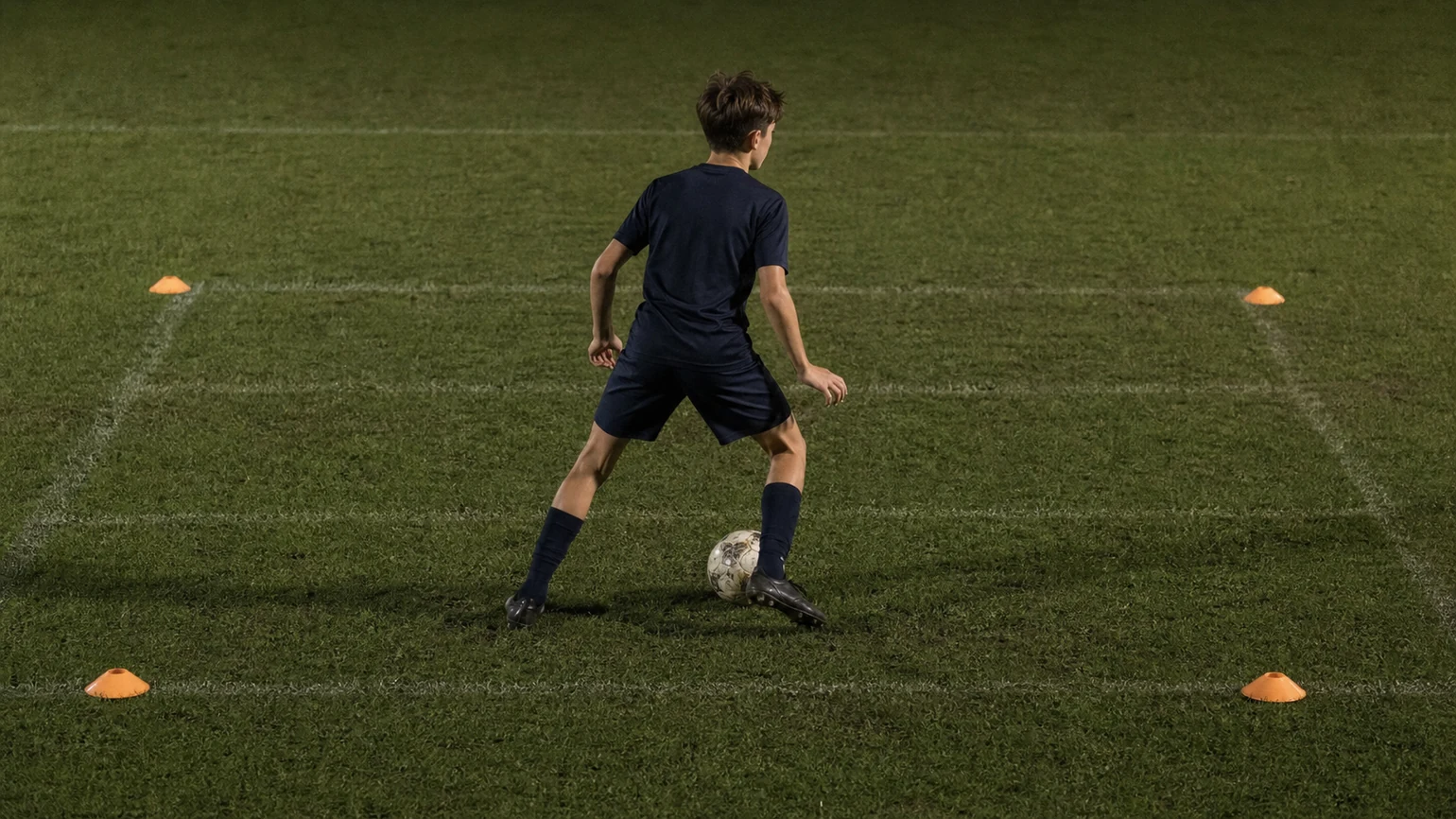
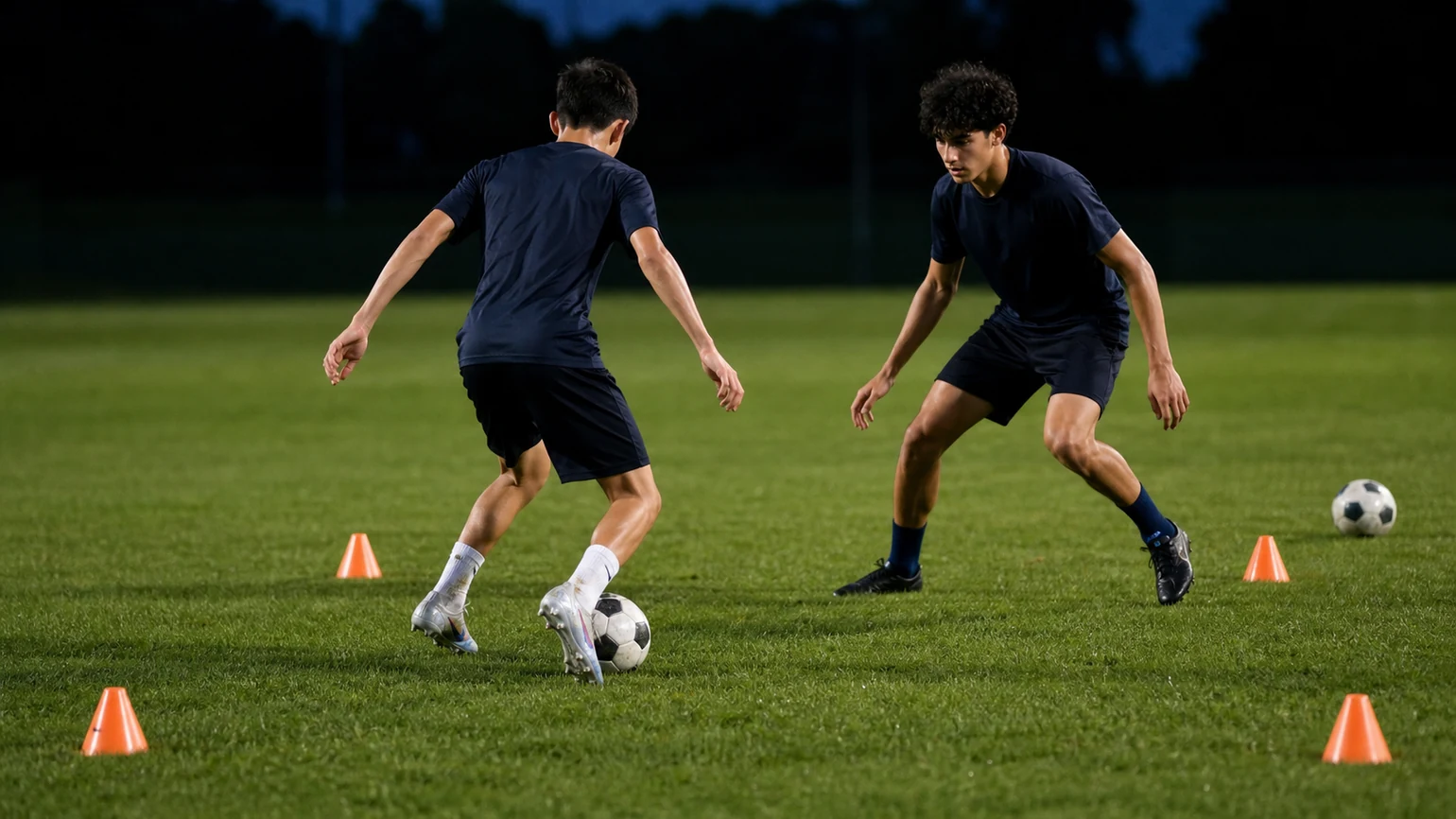
- Mark a small square. One player inside with a ball, one outside with a ball. The outside player dribbles in one side and out another; the inside player wins by touching the moving ball with their own.
- Inside player's rules: never leave the square, keep stepping — no jumping, no matching the attacker's rhythm — and stay pass-ready on every step.
- Focus order: your body over the ball first, then the space and gaps, then the opponent. If you catch yourself only watching the opponent, reset.
- Hit late, not early. Aim where the ball's energy is going, not where it is. Swap roles when the ball is touched. Three rounds each.
Awareness is not a talent. It is four layers, automated one at a time, until your one active focus is free for the only thing that changes: the opponent.
The road continues
Next: Reading the Game
Put the freed-up focus to work: scan timing and what to look for.
Continue